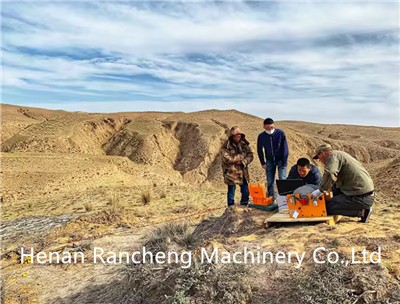
In our geophysical exploration projects, one of the most common and challenging geological problems we encounter is gypsum mine goafs. These underground voids are typically hidden beneath the surface and cannot be directly observed, yet they may gradually evolve into serious hazards such as ground subsidence, surface cracking, and engineering failures.
We have found that gypsum goafs are particularly unstable due to their high solubility and weak structural integrity. Once groundwater enters these voids, the dissolution process may continue over time, causing the underground cavity to expand like an invisible growing risk.
Because of this strong concealment, traditional surface investigation methods are often insufficient. This is why we rely on geophysical exploration technologies to visualize subsurface conditions-effectively turning the underground into something comparable to a "CT scan of the earth," allowing hidden risks to be detected in advance.
Why Gypsum Goafs Are Difficult to Detect in Engineering Projects
In engineering investigations, we often find that gypsum goafs are difficult to identify because they are "quiet" underground. The surface may remain stable for a long period without obvious deformation, while the underground void geometry is irregular and complex. In some cases, voids may also be partially filled with water or collapsed materials, further complicating the physical response.
Due to these conditions, relying only on drilling or empirical judgment is often not enough to understand the full underground situation. We prefer to use geophysical methods to gradually "reveal" subsurface changes-first identifying suspicious zones over a wide area, and then refining the interpretation with higher-resolution methods. This approach is not only more efficient but also closer to real geological conditions.
High-Density Electrical Resistivity Method: Our Primary Tool for Rapid Anomaly Detection
In gypsum goaf investigation, the high-density electrical resistivity method is one of our most frequently used geophysical techniques. It works by injecting electrical current into the ground and measuring resistivity variations at different electrode positions, allowing us to infer subsurface geological structures.
Air-filled voids often appear as high-resistivity anomalies, while water-filled goafs, fractured zones, or saturated cavities tend to show low-resistivity responses. This clear physical contrast makes the method highly effective for early-stage anomaly detection and regional delineation.
Due to its flexibility in field deployment, high data density, and relatively high efficiency, we typically use it as the first step in goaf exploration to define target zones for further detailed investigation.
Microtremor Survey: Imaging Subsurface Structures Using Natural Vibrations
Microtremor surveying is a method we frequently apply in urban and complex environments. It does not require artificial seismic sources. Instead, it collects ambient ground vibrations and extracts Rayleigh wave dispersion characteristics to invert shear-wave velocity structures.
In areas affected by goafs or fractured rock zones, we often observe distinct low-velocity anomalies, which are closely related to reduced rock mass integrity.
This method is particularly suitable for shallow to medium-depth investigations and can be conducted without disrupting normal surface activities, making it widely applicable in urban engineering and infrastructure surveys.
Transient Electromagnetic Method (TEM): Key Technique for Deep Water-Filled Goaf Detection
The transient electromagnetic method (TEM) is one of the most important tools we use for deep subsurface investigations. It is based on electromagnetic induction principles used to characterize underground conductivity structures.
During operation, a pulsed current generates a primary magnetic field. After the current is switched off, induced eddy currents decay within subsurface conductive bodies, and this decay response is recorded and analyzed to infer underground electrical properties.
In gypsum mining areas, water-filled goafs and fractured water-bearing zones often exhibit strong conductive (low-resistivity) anomalies. TEM is particularly effective for detecting deep voids and evaluating groundwater-related risks, with an exploration depth ranging from tens to several hundreds of meters.

3C Seismograph: High-Resolution Imaging of Subsurface Structures
When high-resolution subsurface imaging is required, we use 3C seismic systems equipped with three-component geophones. These sensors record seismic wave motion in multiple directions, providing more complete wavefield information compared to traditional single-component systems.
In goaf detection, underground voids and fractured zones often cause seismic velocity reductions, reflection distortions, and wavefield anomalies. By analyzing these responses, we can interpret the location, geometry, and boundaries of underground cavities with higher accuracy.
Compared with conventional seismic methods, 3C seismic data provides richer information and plays a critical role in detailed geological interpretation under complex conditions.

Integrated Geophysical Interpretation: Our Multi-Method Exploration Strategy
In practical projects, we rarely rely on a single geophysical method. We adopt an integrated interpretation strategy to improve reliability and accuracy.
We first use high-density resistivity surveys to identify anomalous zones quickly, then apply microtremor methods to refine structural boundaries. TEM is used to evaluate deep water-bearing conditions, while 3C seismic data provides high-resolution structural imaging for final validation.
This multi-method combination has been proven in our engineering projects to improve the accuracy and stability of goaf detection results significantly.
Our Geophysical Exploration Equipment Solutions
We specialize in the research, development, and manufacturing of geophysical exploration equipment, and we continuously provide professional instruments and integrated solutions for subsurface investigation worldwide.
Our equipment is widely used in gypsum goaf detection, underground void identification, engineering geological surveys, and groundwater exploration.
Our main product categories include:
- High-density electrical resistivity systems for fast imaging and anomaly detection from shallow to medium depths
- 3C seismic systems for high-resolution subsurface structure imaging and detailed goaf interpretation
- Transient electromagnetic (TEM) systems for deep conductive anomaly detection and water-bearing zone analysis
- Integrated geophysical survey solutions and field data acquisition systems
The hidden nature of gypsum mine goafs makes early detection and evaluation essential for engineering safety. Geophysical exploration methods provide the most effective way to visualize subsurface structures and identify potential risks before they develop into serious hazards.
Through the integrated application of high-density resistivity, microtremor surveying, transient electromagnetic methods, and 3C seismic technology, we are able to detect underground risks earlier, interpret subsurface structures more clearly, and support safer engineering decisions.
We will continue improving our geophysical exploration equipment and solutions, providing more efficient and reliable tools for underground investigation worldwide.